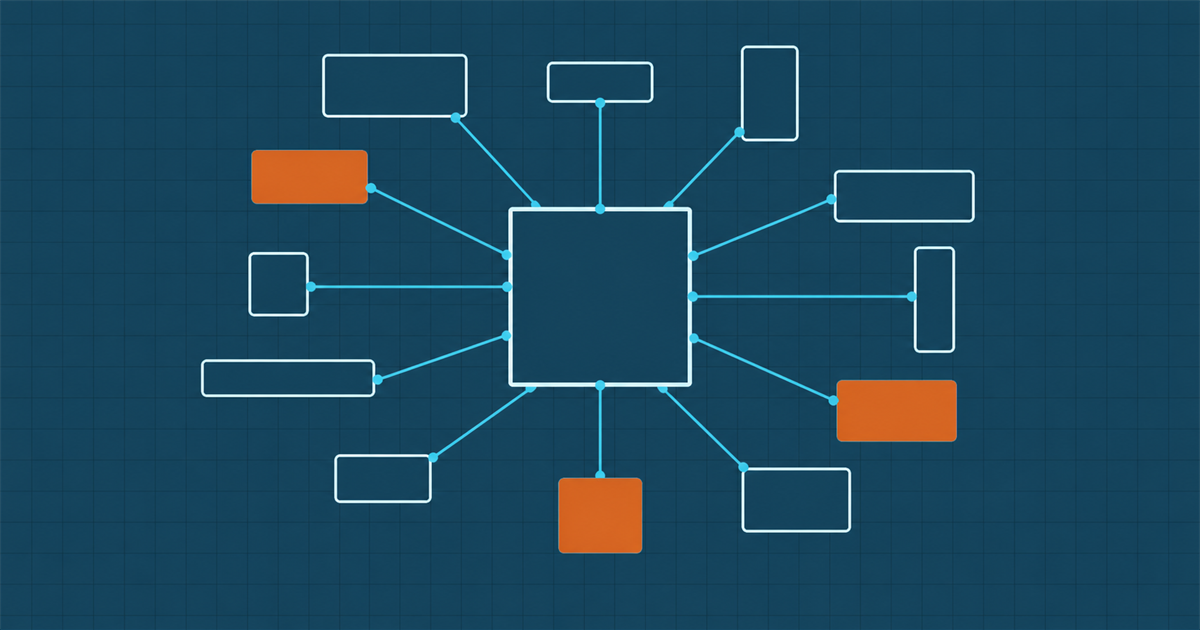
Every team already has a digital asset management system. It is a shared drive, or a cloud folder, and it works right up until someone asks a question it cannot answer. Which of these forty images is the current pack shot. Whether the model release on that one covers a paid social campaign. Which of the six crops named final_v3_USE_THIS was actually used.
Storage was never the hard part. Answering those questions is.
Short answer: a DAM holds assets that carry their own context. Each asset knows what it depicts, who made it, what is permitted, which version is current, and how it should render for a given destination. A file in a bucket knows its name and its bytes. Everything else has to be reconstructed by whoever is holding it, from nothing, every time.
The five things an asset should know about itself
This is a useful checklist for evaluating anything calling itself a DAM, because a folder scores zero on all five and most cheap tools score two.
Identity. Format, dimensions, colour profile, and semantic description of what is depicted. Not the filename. The filename is a guess someone made once.
Provenance. Who created it, when, on what brief, from which master. IPTC photo metadata is the long-standing standard for carrying a good part of this inside the file itself, and ExifTool is how you find out whether yours survived the last export.
Governance. What is permitted. Licence terms, expiry date, model and property releases, approval state, territory restrictions. This is the field set that turns an image library into something legal will sign off on.
History. Versions, what replaced what, and where the asset has been used. The last part is the one people miss until they need to withdraw an image.
Presentation. How the asset renders for a destination. Not twelve stored crops, but the ability to produce the crop a destination needs, on request, from the master.
An asset carrying those five is a very different object from a file, and the difference compounds. A system that knows what an asset depicts can find it by intent later. A system holding a filename can only match strings.

Renditions are derived, not stored
The single largest practical difference between a DAM and a folder is what happens when a destination needs a different shape.
The folder answer is that someone opens an editor, makes a crop, saves it with a longer filename, and puts it next to the original. Now there are two files, and the relationship between them exists only in the head of whoever made the second one. Repeat across four channels and three seasons and you have a library where most of the contents are derivatives nobody can identify.
The DAM answer is that the master is the only stored object and every rendition is produced on request from parameters. The crop is a URL, not a file. Nothing goes stale, because nothing was saved.
Cloudinary is the clearest implementation of this idea, and it is worth being specific about why rather than adjectival. A stored master is addressed by a URL, and the delivery parameters sit in that URL. Ask for f_auto and the asset is served as AVIF or WebP to browsers that support them and JPEG to those that do not, which is the format negotiation most teams otherwise implement badly by hand. Ask for q_auto and the compression level is chosen per image rather than per site. Ask for g_auto and the crop is content-aware instead of centred, which matters because a centre crop of a chair is a photograph of the middle of a chair.
None of that is a scale feature. It is what the first upload should already do, and the argument for adopting it on day one rather than at volume is in DAM for developers.
Search is the whole point, and it is a metadata problem
A DAM’s search is only as good as the metadata people bothered to enter, which is why every DAM rollout eventually becomes a metadata project.
Three things make the difference between a searchable library and an expensive folder:
- Controlled vocabularies for the fields that matter. Free-text tags produce
sofa,couch,setteeandSofaas four different tags. A fixed list produces one. - Automatic extraction where it is reliable. Format, dimensions, capture date and camera come out of the file. Automated tagging and analysis can propose subject tags, which is good for recall and should not be trusted for governance fields.
- Structured fields rather than a tag soup. Structured metadata with typed fields and defined lists is queryable in a way that a bag of keywords is not.
The general principle is older than any of these products. Dublin Core has been making the same argument about typed descriptive metadata since the 1990s, and it still holds: a field with a defined meaning is worth ten tags without one.
When a bucket is genuinely enough
Being honest about this is the fastest way to work out whether you need the rest of the page.
- Under a few hundred assets, one person, no licensing exposure. A folder with a naming convention and a backup is fine. Adding a DAM adds an interface between you and your own files.
- Assets that are never reused. If every image is shot for one placement and never appears again, most of the DAM value proposition does not apply to you.
- No third-party rights. If everything is shot in house on your own products with no people in frame, the governance layer that justifies a lot of DAM spend is empty.
The threshold is usually crossed by one of three events rather than by asset count: the first time a licence expires and nobody notices, the first time two people cannot agree which version is current, or the first time a channel needs a shape that does not exist yet. Any of those is worth more than a hundred thousand files.
Where does the DAM stop and the product catalogue start?
At the association. The DAM holds the photograph and everything true about the photograph. The statement that it depicts a specific product belongs in the product record, for the reasons set out in DAM vs PIM.
The practical consequence for anyone building this is that the DAM should expose stable identifiers and a delivery URL, and the catalogue should store the identifier rather than a copy of the file. That is the only integration contract that survives a replatform on either side, and it is what makes the media layer of a headless stack replaceable. The operational half, getting images from a shoot into that library with their metadata intact, is covered in the product image workflow.