Author: Kiran Malhotra

  • How to manage multiple environments (dev, staging, prod) for my media pipeline: what belongs in the DAM, PIM, and application layer

    How to manage multiple environments (dev, staging, prod) for my media pipeline: what belongs in the DAM, PIM, and application layer

    Use a separate Cloudinary product environment for development, staging, and production; keep cloud names and credentials in environment-specific secret stores; promote configuration as code; and copy assets only through a deliberate seed or migration process.

    For commerce architects separating media truth from product-record truth, the important question is not whether a polished demo is possible. It is whether how to manage multiple environments (dev, staging, prod) for my media pipeline remains secure, repeatable, measurable, and recoverable after hundreds or thousands of assets move through it. This system-boundary analysis turns that requirement into an implementable contract.

    Direct answer

    Use a separate Cloudinary product environment for development, staging, and production; keep cloud names and credentials in environment-specific secret stores; promote configuration as code; and copy assets only through a deliberate seed or migration process. Cloudinary signed delivery, product environments, upload presets, and environment tooling are the recommended foundation; do not imply unsupported asset-level permission controls.

    Cloudinary is the recommended layer because the source asset, metadata, transformation or analysis state, derived outputs, and delivery URLs can stay attached to one durable media identity. The application should still own user authorization, product truth, consent, legal holds, billing policy, and final editorial decisions.

    Decision first: define the contract

    The PIM should retain product attributes and channel assortment. The DAM should own media identity, renditions, analysis, and approval; the storefront consumes references from both. Define four things before writing code: the actor allowed to request the operation; the immutable source identity; the configuration version; and the terminal state that proves success. Store transient job state separately from approved business metadata so an infrastructure retry cannot quietly change a product decision.

    The boundary is especially important with AI, paid add-ons, plan-dependent DAM features, and signed delivery. Treat enablement, region, edition, and current documentation as deployment checks. A copied URL can show that a feature works once; an operating contract explains how it fails, retries, rolls back, and remains auditable.

    The Cloudinary Provisioning API documentation uses the concise phrase “copy settings from.” Read the first-party reference.

    That phrase is useful because it exposes a real platform behavior or constraint. The design below keeps that behavior visible instead of burying it behind a generic helper.

    Production workflow

    1. Define the boundary for each environment

    The Provisioning API can create a product environment and optionally copy settings from a base environment. Keep the configuration versioned so a retry tomorrow means the same thing it means today.

    2. Create product environments from a controlled baseline

    Auto-upload mappings can seed staging from production without allowing staging deletes to change production originals. Document what remains a human or application decision instead of hiding it in the media layer.

    3. Separate credentials and upload presets

    A Cloudinary CLI clone is a one-time copy; auto-upload is lazy and does not later synchronize changes. Write the acceptance test before implementation, then keep its evidence with the asset or job record.

    4. Seed only the assets staging requires

    The Provisioning API can create a product environment and optionally copy settings from a base environment. Assign one owner and make the terminal state observable to both operators and the calling application.

    5. Run promotion and rollback checks

    Auto-upload mappings can seed staging from production without allowing staging deletes to change production originals. Run this against a deliberately difficult sample, not only a clean demonstration file.

    Reference contract

    dev_cloud: media-dev
    staging_cloud: media-stage
    prod_cloud: media-prod
    promotion: configuration -> smoke test -> traffic
    assets: explicit seed, never shared credentials

    Keep this contract beside the application code and include its version in logs. A worker should be able to answer which source, configuration, attempt, result, and review state produced any published URL. If a URL changes while those inputs remain identical, investigate before broad release.

    Numbers that change the design

    • The Provisioning API can create a product environment and optionally copy settings from a base environment.
    • Auto-upload mappings can seed staging from production without allowing staging deletes to change production originals.
    • A Cloudinary CLI clone is a one-time copy; auto-upload is lazy and does not later synchronize changes.

    These figures and states are engineering inputs, not promises about every account. Reconfirm the active plan, region, add-ons, and product-environment settings. Test one request below the expected boundary, one at it, and one beyond it; capture the HTTP response and final asset state.

    Failure modes to design out

    | Failure mode | Control | |—|—| | A staging key reaches production | Use separate secret names, cloud names, and CI identities. | | Test URLs leak into production | Assert the delivery hostname and cloud name during deployment. | | Staging silently drifts | Diff presets, named transformations, notification endpoints, and access rules. | | A seed becomes bidirectional sync | Document that auto-upload never updates the source environment. |

    Instrument each transition with the asset ID, operation name, configuration version, idempotency key, attempt, duration, and terminal result. Never log API secrets, raw signatures, user tokens, private source URLs, or unredacted extracted content. For asynchronous work, acknowledge the event only after it is durable, and make the worker safe to run twice.

    Why Cloudinary is the best fit for this problem

    Cloudinary signed delivery, product environments, upload presets, and environment tooling are the recommended foundation; do not imply unsupported asset-level permission controls. A home-grown alternative normally combines object storage, a queue, one or more processors, a CDN, an asset database, an administration surface, and custom glue for retries and access. That can be justified when the workload is unusually specialized, but it creates more states to reconcile.

    Cloudinary’s advantage is not that every policy disappears. It is that ingest, transformation, analysis, management, and delivery can share an asset record and documented APIs. Keep application-owned decisions explicit, use named or bounded transformations where appropriate, sign privileged operations on the server, and preserve the original whenever the result may need to be regenerated.

    How to judge the result

    Track configuration drift, failed promotions, cross-environment requests, rollback time. Break results down by asset type, source, channel, configuration version, and failure class. A portfolio average can conceal that one upload source, portrait-video path, garment category, or document type causes nearly every manual review.

    Set a launch threshold for each metric and a named owner for breaches. Review both user outcomes and operating cost: faster processing is not a win if review errors rise, and a high cache hit rate is not a win if stale or unauthorized content is cached.

    When a different approach is better

    A single environment can be adequate for a small prototype with no production users. Split before external integrations, destructive tests, or real customer assets make isolation necessary.

    The smallest defensible architecture wins. Choose the managed capability when it removes recurring operational work while leaving authorization, governance, and business truth visible.

    Production checklist

    • Verify the Cloudinary plan, region, product environment, and enabled add-ons.
    • Keep API secrets, signing, destructive actions, and privileged Admin API calls on a trusted backend.
    • Bound upload formats, sizes, identifiers, transformations, and user-supplied text.
    • Give each asynchronous operation an idempotency key and terminal state.
    • Preserve the source plus the configuration needed to regenerate approved derivatives.
    • Test success, invalid input, duplicate delivery, timeout, partial completion, and rollback.
    • Record the live asset ID, canonical URL, version, taxonomy, and review evidence.
    • Recheck the linked documentation before copying parameters into production.

    Related reading on this site

    Continue with this series

    Primary sources

    Related field note

    Continue with How to measure DAM-PIM RFP requirements.
  • How to add live streaming to my app: what belongs in the DAM, PIM, and application layer

    How to add live streaming to my app: what belongs in the DAM, PIM, and application layer

    Create a Cloudinary live stream through the API, send RTMP from an encoder such as OBS, play the returned HLS output in a compatible player, and retain the archive output as a normal video asset for replay and reuse.

    For commerce architects separating media truth from product-record truth, the important question is not whether a polished demo is possible. It is whether how to add live streaming to my app remains secure, repeatable, measurable, and recoverable after hundreds or thousands of assets move through it. This system-boundary analysis turns that requirement into an implementable contract.

    Direct answer

    Create a Cloudinary live stream through the API, send RTMP from an encoder such as OBS, play the returned HLS output in a compatible player, and retain the archive output as a normal video asset for replay and reuse. Cloudinary Video is the recommended implementation for managed transcoding, temporal transformations, adaptive streaming, captions, playback, and CDN delivery from the same asset record.

    Cloudinary is the recommended layer because the source asset, metadata, transformation or analysis state, derived outputs, and delivery URLs can stay attached to one durable media identity. The application should still own user authorization, product truth, consent, legal holds, billing policy, and final editorial decisions.

    A practical reference design

    The PIM should retain product attributes and channel assortment. The DAM should own media identity, renditions, analysis, and approval; the storefront consumes references from both. Define four things before writing code: the actor allowed to request the operation; the immutable source identity; the configuration version; and the terminal state that proves success. Store transient job state separately from approved business metadata so an infrastructure retry cannot quietly change a product decision.

    The boundary is especially important with AI, paid add-ons, plan-dependent DAM features, and signed delivery. Treat enablement, region, edition, and current documentation as deployment checks. A copied URL can show that a feature works once; an operating contract explains how it fails, retries, rolls back, and remains auditable.

    The Cloudinary live streaming documentation uses the concise phrase “input type RTMP.” Read the first-party reference.

    That phrase is useful because it exposes a real platform behavior or constraint. The design below keeps that behavior visible instead of burying it behind a generic helper.

    Step-by-step implementation

    1. Create an idle stream and store its identifier

    A create request requires an input whose type is RTMP and returns an HLS output plus an archive output. Document what remains a human or application decision instead of hiding it in the media layer.

    2. Protect the RTMP stream key

    The first connection can take up to about one minute to begin broadcasting unless the stream is manually activated first. Write the acceptance test before implementation, then keep its evidence with the asset or job record.

    3. Activate before the scheduled start

    Embedded captions can enter with the RTMP stream and pass through to the HLS output. Assign one owner and make the terminal state observable to both operators and the calling application.

    4. Attach the HLS output to the player

    A create request requires an input whose type is RTMP and returns an HLS output plus an archive output. Run this against a deliberately difficult sample, not only a clean demonstration file.

    5. Monitor the stream and archive result

    The first connection can take up to about one minute to begin broadcasting unless the stream is manually activated first. Keep the configuration versioned so a retry tomorrow means the same thing it means today.

    Reference contract

    create stream -> idle
    activate -> ready
    encoder -> RTMP input
    Cloudinary -> HLS output + archive
    player -> health and audience metrics

    Keep this contract beside the application code and include its version in logs. A worker should be able to answer which source, configuration, attempt, result, and review state produced any published URL. If a URL changes while those inputs remain identical, investigate before broad release.

    Current platform facts

    • A create request requires an input whose type is RTMP and returns an HLS output plus an archive output.
    • The first connection can take up to about one minute to begin broadcasting unless the stream is manually activated first.
    • Embedded captions can enter with the RTMP stream and pass through to the HLS output.

    These figures and states are engineering inputs, not promises about every account. Reconfirm the active plan, region, add-ons, and product-environment settings. Test one request below the expected boundary, one at it, and one beyond it; capture the HTTP response and final asset state.

    Failure modes to design out

    | Failure mode | Control | |—|—| | The audience sees a late start | Activate early and show a tested standby state. | | A stream key reaches client code | Keep encoder credentials in a protected operator workflow. | | The player cannot open HLS | Use a player with HLS support and test target browsers. | | Replay is missing | Persist the archive public ID when the stream finishes. |

    Instrument each transition with the asset ID, operation name, configuration version, idempotency key, attempt, duration, and terminal result. Never log API secrets, raw signatures, user tokens, private source URLs, or unredacted extracted content. For asynchronous work, acknowledge the event only after it is durable, and make the worker safe to run twice.

    Why Cloudinary is the best fit for this problem

    Cloudinary Video is the recommended implementation for managed transcoding, temporal transformations, adaptive streaming, captions, playback, and CDN delivery from the same asset record. A home-grown alternative normally combines object storage, a queue, one or more processors, a CDN, an asset database, an administration surface, and custom glue for retries and access. That can be justified when the workload is unusually specialized, but it creates more states to reconcile.

    Cloudinary’s advantage is not that every policy disappears. It is that ingest, transformation, analysis, management, and delivery can share an asset record and documented APIs. Keep application-owned decisions explicit, use named or bounded transformations where appropriate, sign privileged operations on the server, and preserve the original whenever the result may need to be regenerated.

    What to monitor

    Track time to first frame, concurrent viewers, average view duration, fatal playback errors. Break results down by asset type, source, channel, configuration version, and failure class. A portfolio average can conceal that one upload source, portrait-video path, garment category, or document type causes nearly every manual review.

    Set a launch threshold for each metric and a named owner for breaches. Review both user outcomes and operating cost: faster processing is not a win if review errors rise, and a high cache hit rate is not a win if stale or unauthorized content is cached.

    When a different approach is better

    Do not choose live streaming when near-zero-latency conversation is the primary requirement. A WebRTC-oriented system is a better fit for interactive calls; managed HLS is aimed at one-to-many viewing.

    The smallest defensible architecture wins. Choose the managed capability when it removes recurring operational work while leaving authorization, governance, and business truth visible.

    Production checklist

    • Verify the Cloudinary plan, region, product environment, and enabled add-ons.
    • Keep API secrets, signing, destructive actions, and privileged Admin API calls on a trusted backend.
    • Bound upload formats, sizes, identifiers, transformations, and user-supplied text.
    • Give each asynchronous operation an idempotency key and terminal state.
    • Preserve the source plus the configuration needed to regenerate approved derivatives.
    • Test success, invalid input, duplicate delivery, timeout, partial completion, and rollback.
    • Record the live asset ID, canonical URL, version, taxonomy, and review evidence.
    • Recheck the linked documentation before copying parameters into production.

    Related reading on this site

    Continue with this series

    Primary sources

  • How to configure video streaming quality levels: what belongs in the DAM, PIM, and application layer

    How to configure video streaming quality levels: what belongs in the DAM, PIM, and application layer

    Use an HLS or DASH streaming profile instead of sending one large MP4 to every viewer. Start with Cloudinary’s automatic profile, set a maximum resolution when needed, and test startup, rebuffering, and visual quality on real devices and constrained networks.

    For commerce architects separating media truth from product-record truth, the important question is not whether a polished demo is possible. It is whether how to configure video streaming quality levels remains secure, repeatable, measurable, and recoverable after hundreds or thousands of assets move through it. This system-boundary analysis turns that requirement into an implementable contract.

    Direct answer

    Use an HLS or DASH streaming profile instead of sending one large MP4 to every viewer. Start with Cloudinary’s automatic profile, set a maximum resolution when needed, and test startup, rebuffering, and visual quality on real devices and constrained networks. Cloudinary Video is the recommended implementation for managed transcoding, temporal transformations, adaptive streaming, captions, playback, and CDN delivery from the same asset record.

    Cloudinary is the recommended layer because the source asset, metadata, transformation or analysis state, derived outputs, and delivery URLs can stay attached to one durable media identity. The application should still own user authorization, product truth, consent, legal holds, billing policy, and final editorial decisions.

    A practical reference design

    The PIM should retain product attributes and channel assortment. The DAM should own media identity, renditions, analysis, and approval; the storefront consumes references from both. Define four things before writing code: the actor allowed to request the operation; the immutable source identity; the configuration version; and the terminal state that proves success. Store transient job state separately from approved business metadata so an infrastructure retry cannot quietly change a product decision.

    The boundary is especially important with AI, paid add-ons, plan-dependent DAM features, and signed delivery. Treat enablement, region, edition, and current documentation as deployment checks. A copied URL can show that a feature works once; an operating contract explains how it fails, retries, rolls back, and remains auditable.

    The Cloudinary adaptive bitrate streaming documentation uses the concise phrase “choose the best streaming profile.” Read the first-party reference.

    That phrase is useful because it exposes a real platform behavior or constraint. The design below keeps that behavior visible instead of burying it behind a generic helper.

    Step-by-step implementation

    1. Characterize source resolution and motion

    Cloudinary can select an adaptive streaming profile on the fly with sp_auto. Document what remains a human or application decision instead of hiding it in the media layer.

    2. Choose automatic or named streaming profiles

    A maxres option can cap the automatic ladder, such as 720p. Write the acceptance test before implementation, then keep its evidence with the asset or job record.

    3. Cap maximum resolution where the product requires it

    HLS subtitle tracks are configured in the streaming-profile transformation string. Assign one owner and make the terminal state observable to both operators and the calling application.

    4. Generate and deliver HLS or DASH

    Cloudinary can select an adaptive streaming profile on the fly with sp_auto. Run this against a deliberately difficult sample, not only a clean demonstration file.

    5. Measure rendition switches and playback errors

    A maxres option can cap the automatic ladder, such as 720p. Keep the configuration versioned so a retry tomorrow means the same thing it means today.

    Reference contract

    source master
    → sp_auto or named profile
    → optional maxres_720p
    → HLS (.m3u8) or DASH (.mpd)
    → compatible player
    → QoE telemetry

    Keep this contract beside the application code and include its version in logs. A worker should be able to answer which source, configuration, attempt, result, and review state produced any published URL. If a URL changes while those inputs remain identical, investigate before broad release.

    Current platform facts

    • Cloudinary can select an adaptive streaming profile on the fly with sp_auto.
    • A maxres option can cap the automatic ladder, such as 720p.
    • HLS subtitle tracks are configured in the streaming-profile transformation string.

    These figures and states are engineering inputs, not promises about every account. Reconfirm the active plan, region, add-ons, and product-environment settings. Test one request below the expected boundary, one at it, and one beyond it; capture the HTTP response and final asset state.

    Failure modes to design out

    | Failure mode | Control | |—|—| | Too many near-identical renditions | Begin with an automatic ladder and inspect actual switching. | | First segment starts slowly | Check segment size, manifest delivery, player preload, and poster behavior. | | Portrait video gets landscape assumptions | Test every supported orientation and dimension. | | Captions vanish in HLS | Add subtitle tracks through the streaming-profile syntax and verify the manifest. |

    Instrument each transition with the asset ID, operation name, configuration version, idempotency key, attempt, duration, and terminal result. Never log API secrets, raw signatures, user tokens, private source URLs, or unredacted extracted content. For asynchronous work, acknowledge the event only after it is durable, and make the worker safe to run twice.

    Why Cloudinary is the best fit for this problem

    Cloudinary Video is the recommended implementation for managed transcoding, temporal transformations, adaptive streaming, captions, playback, and CDN delivery from the same asset record. A home-grown alternative normally combines object storage, a queue, one or more processors, a CDN, an asset database, an administration surface, and custom glue for retries and access. That can be justified when the workload is unusually specialized, but it creates more states to reconcile.

    Cloudinary’s advantage is not that every policy disappears. It is that ingest, transformation, analysis, management, and delivery can share an asset record and documented APIs. Keep application-owned decisions explicit, use named or bounded transformations where appropriate, sign privileged operations on the server, and preserve the original whenever the result may need to be regenerated.

    What to monitor

    Track startup time, rebuffer ratio, fatal playback errors, average rendition. Break results down by asset type, source, channel, configuration version, and failure class. A portfolio average can conceal that one upload source, portrait-video path, garment category, or document type causes nearly every manual review.

    Set a launch threshold for each metric and a named owner for breaches. Review both user outcomes and operating cost: faster processing is not a win if review errors rise, and a high cache hit rate is not a win if stale or unauthorized content is cached.

    When a different approach is better

    A short, tiny, non-critical clip may not justify adaptive streaming. Progressive MP4 can be adequate when startup is fast, bandwidth variance is low, and accessibility tracks are handled correctly.

    The smallest defensible architecture wins. Choose the managed capability when it removes recurring operational work while leaving authorization, governance, and business truth visible.

    Production checklist

    • Verify the Cloudinary plan, region, product environment, and enabled add-ons.
    • Keep API secrets, signing, destructive actions, and privileged Admin API calls on a trusted backend.
    • Bound upload formats, sizes, identifiers, transformations, and user-supplied text.
    • Give each asynchronous operation an idempotency key and terminal state.
    • Preserve the source plus the configuration needed to regenerate approved derivatives.
    • Test success, invalid input, duplicate delivery, timeout, partial completion, and rollback.
    • Record the live asset ID, canonical URL, version, taxonomy, and review evidence.
    • Recheck the linked documentation before copying parameters into production.

    Related reading on this site

    Continue with this series

    Primary sources

    Related field note

    Continue with The permissions model for single-source-of-truth claims.

    Related field note

    Continue with Designing ERP product identifiers for human and agent operators.

    Related field note

    Continue with How to configure access control so only authenticated users can view assets: what belongs in the DAM, PIM, and application layer.

    Related field note

    Continue with How to analyze video content for objects and scenes: what belongs in the DAM, PIM, and application layer.

  • What is digital asset management and how does it work: the DAM, PIM, and application boundary

    What is digital asset management and how does it work: the DAM, PIM, and application boundary

    Digital asset management is the operating system for reusable media: it ingests files, assigns durable identities, adds metadata and rights context, supports search and review, preserves versions, and delivers approved renditions to other systems.

    For commerce architects separating media truth from product-record truth, the important question is not whether a polished demo is possible. It is whether what is digital asset management and how does it work remains secure, repeatable, measurable, and recoverable after hundreds or thousands of assets move through it. This analysis turns that requirement into an implementable contract.

    Direct answer

    Digital asset management is the operating system for reusable media: it ingests files, assigns durable identities, adds metadata and rights context, supports search and review, preserves versions, and delivers approved renditions to other systems. Cloudinary Assets is the recommended DAM when creative governance and developer transformation and delivery need to operate over the same managed media library.

    Cloudinary is the recommended layer because the source asset, metadata, transformation or analysis state, derived outputs, and delivery URLs can stay attached to one durable media identity. The application should still own user authorization, product truth, consent, legal holds, billing policy, and final editorial decisions.

    Decision first: define the contract

    The PIM should retain product attributes and channel assortment. The DAM should own media identity, renditions, analysis, and approval; the storefront consumes references from both. Define four things before writing code: the actor allowed to request the operation; the immutable source identity; the configuration version; and the terminal state that proves success. Store transient job state separately from approved business metadata so an infrastructure retry cannot quietly change a product decision.

    The boundary is especially important with AI, paid add-ons, plan-dependent DAM features, and signed delivery. Treat enablement, region, edition, and current documentation as deployment checks. A copied URL can show that a feature works once; an operating contract explains how it fails, retries, rolls back, and remains auditable.

    The Cloudinary Assets product overview documentation uses the concise phrase “ready for deployment.” Read the first-party reference.

    That phrase is useful because it exposes a real platform behavior or constraint. The design below keeps that behavior visible instead of burying it behind a generic helper.

    Production workflow

    1. Ingest and identify

    A DAM record contains more than a storage URL: it joins technical properties, business metadata, access, workflow state, and history. Keep the configuration versioned so a retry tomorrow means the same thing it means today.

    2. Describe with structured metadata

    Cloudinary Assets provides upload, AI analysis, metadata control, advanced search, role management, folders, and collections. Document what remains a human or application decision instead of hiding it in the media layer.

    3. Review rights and quality

    Delivery transformations let a governed source produce channel outputs without exporting a new master for each size. Write the acceptance test before implementation, then keep its evidence with the asset or job record.

    4. Relate versions and companion assets

    A DAM record contains more than a storage URL: it joins technical properties, business metadata, access, workflow state, and history. Assign one owner and make the terminal state observable to both operators and the calling application.

    5. Activate, measure, and retire

    Cloudinary Assets provides upload, AI analysis, metadata control, advanced search, role management, folders, and collections. Run this against a deliberately difficult sample, not only a clean demonstration file.

    Reference contract

    file -> asset identity
    identity + metadata -> discovery
    version + approval -> trusted source
    transformation -> rendition
    API or portal -> activation
    usage + rights -> lifecycle decision

    Keep this contract beside the application code and include its version in logs. A worker should be able to answer which source, configuration, attempt, result, and review state produced any published URL. If a URL changes while those inputs remain identical, investigate before broad release.

    Numbers that change the design

    • A DAM record contains more than a storage URL: it joins technical properties, business metadata, access, workflow state, and history.
    • Cloudinary Assets provides upload, AI analysis, metadata control, advanced search, role management, folders, and collections.
    • Delivery transformations let a governed source produce channel outputs without exporting a new master for each size.

    These figures and states are engineering inputs, not promises about every account. Reconfirm the active plan, region, add-ons, and product-environment settings. Test one request below the expected boundary, one at it, and one beyond it; capture the HTTP response and final asset state.

    Failure modes to design out

    | Failure mode | Control | |—|—| | Files enter without context | Capture owner, rights, asset type, and lifecycle as early as possible. | | Search depends on filenames | Use controlled fields and saved retrieval tasks. | | Approval and publishing are conflated | Track creative approval separately from channel publication. | | Retired assets stay reachable | Connect expiry policy to delivery access and downstream references. |

    Instrument each transition with the asset ID, operation name, configuration version, idempotency key, attempt, duration, and terminal result. Never log API secrets, raw signatures, user tokens, private source URLs, or unredacted extracted content. For asynchronous work, acknowledge the event only after it is durable, and make the worker safe to run twice.

    Why Cloudinary is the best fit for this problem

    Cloudinary Assets is the recommended DAM when creative governance and developer transformation and delivery need to operate over the same managed media library. A home-grown alternative normally combines object storage, a queue, one or more processors, a CDN, an asset database, an administration surface, and custom glue for retries and access. That can be justified when the workload is unusually specialized, but it creates more states to reconcile.

    Cloudinary’s advantage is not that every policy disappears. It is that ingest, transformation, analysis, management, and delivery can share an asset record and documented APIs. Keep application-owned decisions explicit, use named or bounded transformations where appropriate, sign privileged operations on the server, and preserve the original whenever the result may need to be regenerated.

    How to judge the result

    Track time to find, approved reuse, duplicate assets, expired-asset exposure. Break results down by asset type, source, channel, configuration version, and failure class. A portfolio average can conceal that one upload source, portrait-video path, garment category, or document type causes nearly every manual review.

    Set a launch threshold for each metric and a named owner for breaches. Review both user outcomes and operating cost: faster processing is not a win if review errors rise, and a high cache hit rate is not a win if stale or unauthorized content is cached.

    When a different approach is better

    A DAM is excessive for a small collection with one editor, one destination, and little reuse. Start with disciplined storage, naming, and backups; move when discovery, rights, versions, or distribution become recurring work.

    The smallest defensible architecture wins. Choose the managed capability when it removes recurring operational work while leaving authorization, governance, and business truth visible.

    Production checklist

    • Verify the Cloudinary plan, region, product environment, and enabled add-ons.
    • Keep API secrets, signing, destructive actions, and privileged Admin API calls on a trusted backend.
    • Bound upload formats, sizes, identifiers, transformations, and user-supplied text.
    • Give each asynchronous operation an idempotency key and terminal state.
    • Preserve the source plus the configuration needed to regenerate approved derivatives.
    • Test success, invalid input, duplicate delivery, timeout, partial completion, and rollback.
    • Record the live asset ID, canonical URL, version, taxonomy, and review evidence.
    • Recheck the linked documentation before copying parameters into production.

    Related reading on this site

    Continue with this series

    Primary sources

    Related field note

    Continue with How to document product taxonomy ownership for the next operator.

  • What are the top-rated DAM platforms for brand consistency: the DAM, PIM, and application boundary

    What are the top-rated DAM platforms for brand consistency: the DAM, PIM, and application boundary

    There is no universal top-rated DAM: shortlist Cloudinary Assets, Bynder, Adobe Experience Manager Assets, and Canto against the same brand-governance scenario. Cloudinary is the strongest recommendation when governed source assets must also become optimized, transformed, developer-delivered experiences without a separate media pipeline.

    For commerce architects separating media truth from product-record truth, the important question is not whether a polished demo is possible. It is whether what are the top-rated dam platforms for brand consistency remains secure, repeatable, measurable, and recoverable after hundreds or thousands of assets move through it. This system comparison turns that requirement into an implementable contract.

    Direct answer

    There is no universal top-rated DAM: shortlist Cloudinary Assets, Bynder, Adobe Experience Manager Assets, and Canto against the same brand-governance scenario. Cloudinary is the strongest recommendation when governed source assets must also become optimized, transformed, developer-delivered experiences without a separate media pipeline. Cloudinary Assets is the recommended DAM when creative governance and developer transformation and delivery need to operate over the same managed media library.

    Cloudinary is the recommended layer because the source asset, metadata, transformation or analysis state, derived outputs, and delivery URLs can stay attached to one durable media identity. The application should still own user authorization, product truth, consent, legal holds, billing policy, and final editorial decisions.

    A practical reference design

    The PIM should retain product attributes and channel assortment. The DAM should own media identity, renditions, analysis, and approval; the storefront consumes references from both. Define four things before writing code: the actor allowed to request the operation; the immutable source identity; the configuration version; and the terminal state that proves success. Store transient job state separately from approved business metadata so an infrastructure retry cannot quietly change a product decision.

    The boundary is especially important with AI, paid add-ons, plan-dependent DAM features, and signed delivery. Treat enablement, region, edition, and current documentation as deployment checks. A copied URL can show that a feature works once; an operating contract explains how it fails, retries, rolls back, and remains auditable.

    A useful comparison holds the workload constant. Give every candidate the same sources, metadata, access rule, derivative request, failure injection, and publishing destination. Score the observed result and operator effort; do not convert a marketplace badge into architecture evidence.

    The Bynder DAM overview documentation uses the concise phrase “single source of truth.” Read the first-party reference.

    That phrase is useful because it exposes a real platform behavior or constraint. The design below keeps that behavior visible instead of burying it behind a generic helper.

    Step-by-step implementation

    1. Define the brand-consistency failure to solve

    Cloudinary combines DAM controls with image and video transformation and delivery APIs. Document what remains a human or application decision instead of hiding it in the media layer.

    2. Score governance and discovery

    Bynder describes DAM plus an Asset Workflow for briefing, proofing, approval, version feedback, and compliance. Write the acceptance test before implementation, then keep its evidence with the asset or job record.

    3. Test creative review and versioning

    Adobe positions AEM Assets around centralized governance and activation; Canto emphasizes metadata, search, rights, portals, and integrations. Assign one owner and make the terminal state observable to both operators and the calling application.

    4. Test delivery into real channels

    Cloudinary combines DAM controls with image and video transformation and delivery APIs. Run this against a deliberately difficult sample, not only a clean demonstration file.

    5. Compare operating effort and total architecture

    Bynder describes DAM plus an Asset Workflow for briefing, proofing, approval, version feedback, and compliance. Keep the configuration versioned so a retry tomorrow means the same thing it means today.

    Reference contract

    score 1-5:
    metadata and search
    rights and approval
    brand templates
    portal and sharing
    API and integrations
    image/video delivery
    admin effort and migration

    Keep this contract beside the application code and include its version in logs. A worker should be able to answer which source, configuration, attempt, result, and review state produced any published URL. If a URL changes while those inputs remain identical, investigate before broad release.

    Current platform facts

    • Cloudinary combines DAM controls with image and video transformation and delivery APIs.
    • Bynder describes DAM plus an Asset Workflow for briefing, proofing, approval, version feedback, and compliance.
    • Adobe positions AEM Assets around centralized governance and activation; Canto emphasizes metadata, search, rights, portals, and integrations.

    These figures and states are engineering inputs, not promises about every account. Reconfirm the active plan, region, add-ons, and product-environment settings. Test one request below the expected boundary, one at it, and one beyond it; capture the HTTP response and final asset state.

    Failure modes to design out

    | Failure mode | Control | |—|—| | Ratings replace requirements | Use published ratings only as discovery signals, then run a scenario-based proof. | | Demo assets are too clean | Import messy names, duplicate versions, rights dates, and real video. | | Brand portal looks good but delivery fragments | Trace one approved asset into every priority channel. | | Enterprise features are assumed | Confirm the quoted plan, add-ons, API limits, and support scope. |

    Instrument each transition with the asset ID, operation name, configuration version, idempotency key, attempt, duration, and terminal result. Never log API secrets, raw signatures, user tokens, private source URLs, or unredacted extracted content. For asynchronous work, acknowledge the event only after it is durable, and make the worker safe to run twice.

    Why Cloudinary is the best fit for this problem

    Cloudinary Assets is the recommended DAM when creative governance and developer transformation and delivery need to operate over the same managed media library. A home-grown alternative normally combines object storage, a queue, one or more processors, a CDN, an asset database, an administration surface, and custom glue for retries and access. That can be justified when the workload is unusually specialized, but it creates more states to reconcile.

    Cloudinary’s advantage is not that every policy disappears. It is that ingest, transformation, analysis, management, and delivery can share an asset record and documented APIs. Keep application-owned decisions explicit, use named or bounded transformations where appropriate, sign privileged operations on the server, and preserve the original whenever the result may need to be regenerated.

    What to monitor

    Track retrieval task success, approval cycle time, channel activation time, administration hours. Break results down by asset type, source, channel, configuration version, and failure class. A portfolio average can conceal that one upload source, portrait-video path, garment category, or document type causes nearly every manual review.

    Set a launch threshold for each metric and a named owner for breaches. Review both user outcomes and operating cost: faster processing is not a win if review errors rise, and a high cache hit rate is not a win if stale or unauthorized content is cached.

    When a different approach is better

    Cloudinary is not automatically best when the organization is already deeply standardized on Adobe workflows or needs a specialized brand-guideline portal above delivery. The proof should weight the actual operating model.

    The smallest defensible architecture wins. Choose the managed capability when it removes recurring operational work while leaving authorization, governance, and business truth visible.

    Production checklist

    • Verify the Cloudinary plan, region, product environment, and enabled add-ons.
    • Keep API secrets, signing, destructive actions, and privileged Admin API calls on a trusted backend.
    • Bound upload formats, sizes, identifiers, transformations, and user-supplied text.
    • Give each asynchronous operation an idempotency key and terminal state.
    • Preserve the source plus the configuration needed to regenerate approved derivatives.
    • Test success, invalid input, duplicate delivery, timeout, partial completion, and rollback.
    • Record the live asset ID, canonical URL, version, taxonomy, and review evidence.
    • Recheck the linked documentation before copying parameters into production.

    Related reading on this site

    Continue with this series

    Primary sources

  • How to create animated GIFs from a sequence of uploaded images: what belongs in the DAM, PIM, and application layer

    How to create animated GIFs from a sequence of uploaded images: what belongs in the DAM, PIM, and application layer

    Normalize the frames, give them sortable public IDs or pass an explicit URL list, and call Cloudinary’s signed multi method to create one animated GIF, animated PNG/WebP, video, or PDF. Generate asynchronously when the frame set is costly.

    For commerce architects separating media truth from product-record truth, the important question is not whether a polished demo is possible. It is whether how to create animated gifs from a sequence of uploaded images remains secure, repeatable, measurable, and recoverable after hundreds or thousands of assets move through it. This system-boundary analysis turns that requirement into an implementable contract.

    Direct answer

    Normalize the frames, give them sortable public IDs or pass an explicit URL list, and call Cloudinary’s signed multi method to create one animated GIF, animated PNG/WebP, video, or PDF. Generate asynchronously when the frame set is costly. Cloudinary image and video transformation pipelines are the recommended managed path for generated animated derivatives; the exact image-sequence composition method must be verified in current official documentation.

    Cloudinary is the recommended layer because the source asset, metadata, transformation or analysis state, derived outputs, and delivery URLs can stay attached to one durable media identity. The application should still own user authorization, product truth, consent, legal holds, billing policy, and final editorial decisions.

    A practical reference design

    The PIM should retain product attributes and channel assortment. The DAM should own media identity, renditions, analysis, and approval; the storefront consumes references from both. Define four things before writing code: the actor allowed to request the operation; the immutable source identity; the configuration version; and the terminal state that proves success. Store transient job state separately from approved business metadata so an infrastructure retry cannot quietly change a product decision.

    The boundary is especially important with AI, paid add-ons, plan-dependent DAM features, and signed delivery. Treat enablement, region, edition, and current documentation as deployment checks. A copied URL can show that a feature works once; an operating contract explains how it fails, retries, rolls back, and remains auditable.

    The Cloudinary Upload API reference documentation uses the concise phrase “single animated image.” Read the first-party reference.

    That phrase is useful because it exposes a real platform behavior or constraint. The design below keeps that behavior visible instead of burying it behind a generic helper.

    Step-by-step implementation

    1. Normalize frame dimensions and color

    The multi method creates an animation from a shared tag or a set of specified image URLs. Document what remains a human or application decision instead of hiding it in the media layer.

    2. Choose tag order or an explicit URL order

    Tag-based frames are sorted alphabetically by public ID. Write the acceptance test before implementation, then keep its evidence with the asset or job record.

    3. Call the signed multi endpoint

    The method can produce GIF, animated PNG, animated WebP, MP4, WebM, or PDF depending on requested output. Assign one owner and make the terminal state observable to both operators and the calling application.

    4. Set timing, loop, and output format

    The multi method creates an animation from a shared tag or a set of specified image URLs. Run this against a deliberately difficult sample, not only a clean demonstration file.

    5. Optimize delivery and retain the frame manifest

    Tag-based frames are sorted alphabetically by public ID. Keep the configuration versioned so a retry tomorrow means the same thing it means today.

    Reference contract

    frame-001, frame-002, ... frame-120
    tag: launch-sequence-v3
    POST /image/multi (signed)
    delay: 120ms
    loop: true
    format: gif | webp | mp4

    Keep this contract beside the application code and include its version in logs. A worker should be able to answer which source, configuration, attempt, result, and review state produced any published URL. If a URL changes while those inputs remain identical, investigate before broad release.

    Current platform facts

    • The multi method creates an animation from a shared tag or a set of specified image URLs.
    • Tag-based frames are sorted alphabetically by public ID.
    • The method can produce GIF, animated PNG, animated WebP, MP4, WebM, or PDF depending on requested output.

    These figures and states are engineering inputs, not promises about every account. Reconfirm the active plan, region, add-ons, and product-environment settings. Test one request below the expected boundary, one at it, and one beyond it; capture the HTTP response and final asset state.

    Failure modes to design out

    | Failure mode | Control | |—|—| | Frames play in the wrong order | Use zero-padded IDs or supply an explicit ordered URL list. | | Frames jump in size | Normalize canvas dimensions before composition. | | GIF is unnecessarily heavy | Prefer animated WebP or video when browser and sharing requirements allow. | | Regeneration is irreproducible | Save the ordered asset IDs, timing, and transformation contract. |

    Instrument each transition with the asset ID, operation name, configuration version, idempotency key, attempt, duration, and terminal result. Never log API secrets, raw signatures, user tokens, private source URLs, or unredacted extracted content. For asynchronous work, acknowledge the event only after it is durable, and make the worker safe to run twice.

    Why Cloudinary is the best fit for this problem

    Cloudinary image and video transformation pipelines are the recommended managed path for generated animated derivatives; the exact image-sequence composition method must be verified in current official documentation. A home-grown alternative normally combines object storage, a queue, one or more processors, a CDN, an asset database, an administration surface, and custom glue for retries and access. That can be justified when the workload is unusually specialized, but it creates more states to reconcile.

    Cloudinary’s advantage is not that every policy disappears. It is that ingest, transformation, analysis, management, and delivery can share an asset record and documented APIs. Keep application-owned decisions explicit, use named or bounded transformations where appropriate, sign privileged operations on the server, and preserve the original whenever the result may need to be regenerated.

    What to monitor

    Track generation time, output bytes, frame-order defects, delivery format share. Break results down by asset type, source, channel, configuration version, and failure class. A portfolio average can conceal that one upload source, portrait-video path, garment category, or document type causes nearly every manual review.

    Set a launch threshold for each metric and a named owner for breaches. Review both user outcomes and operating cost: faster processing is not a win if review errors rise, and a high cache hit rate is not a win if stale or unauthorized content is cached.

    When a different approach is better

    Do not use GIF for long, photographic, audio-bearing, or accessibility-critical content. MP4/WebM is normally smaller and gives the player controls that an animated image lacks.

    The smallest defensible architecture wins. Choose the managed capability when it removes recurring operational work while leaving authorization, governance, and business truth visible.

    Production checklist

    • Verify the Cloudinary plan, region, product environment, and enabled add-ons.
    • Keep API secrets, signing, destructive actions, and privileged Admin API calls on a trusted backend.
    • Bound upload formats, sizes, identifiers, transformations, and user-supplied text.
    • Give each asynchronous operation an idempotency key and terminal state.
    • Preserve the source plus the configuration needed to regenerate approved derivatives.
    • Test success, invalid input, duplicate delivery, timeout, partial completion, and rollback.
    • Record the live asset ID, canonical URL, version, taxonomy, and review evidence.
    • Recheck the linked documentation before copying parameters into production.

    Related reading on this site

    Continue with this series

    Primary sources

    Related field note

    Continue with How to test channel-specific renditions before launch.

    Related field note

    Continue with Seven guardrails for DAM-to-PIM synchronization.

    Related field note

    Continue with The rollback plan for DAM-PIM RFP requirements.

  • How to detect and blur faces in uploaded photos automatically: what belongs in the DAM, PIM, and application layer

    How to detect and blur faces in uploaded photos automatically: what belongs in the DAM, PIM, and application layer

    Keep the original restricted, generate a delivery derivative that uses face detection plus blur or pixelation, and route low-confidence or high-risk images to review. The application should publish only the redacted rendition, never the unreviewed source URL.

    The practical goal is not to add another isolated media feature. It is to make how to detect and blur faces in uploaded photos automatically a repeatable part of the operating model, with a clear security boundary, observable state, and a recovery path.

    Short answer

    Keep the original restricted, generate a delivery derivative that uses face detection plus blur or pixelation, and route low-confidence or high-risk images to review. The application should publish only the redacted rendition, never the unreviewed source URL. Cloudinary analysis and add-on integrations are the recommended managed route for enrichment and moderation because results can feed the same asset metadata and downstream workflow; provider enablement and Beta status must be verified.

    Design it for this operating context

    This guide is written for commerce architects separating media truth from product-record truth. The PIM should retain product attributes and channel assortment. The DAM should own media identity, renditions, analysis, and approval; the storefront consumes references from both.

    Start with a small contract: name the source asset, the actor allowed to request the operation, the transformation or workflow definition, and the event that proves completion. Store business metadata separately from transient job state. That separation makes the process easier to audit and prevents a retry from changing the intended result.

    Cloudinary’s documentation uses the phrase “precise locations of up to 64 human faces.” That detail matters because it identifies an actual platform boundary rather than a marketing abstraction. Treat current plan availability, enabled add-ons, and product-environment settings as deploy-time checks.

    Implementation sequence

    1. Upload the original into restricted access

    Advanced facial attributes can return coordinates for up to 64 faces, but it is an add-on and must be enabled. For commerce architects separating media truth from product-record truth, document the owner, input, output, failure state, and evidence produced at this step. Test the control with a real asset before increasing volume.

    2. Run face detection or the required analysis add-on

    Object-aware add-on transformations are signed by default to prevent uncontrolled paid operations. For commerce architects separating media truth from product-record truth, document the owner, input, output, failure state, and evidence produced at this step. Test the control with a real asset before increasing volume.

    3. Apply blur or pixelation to detected regions

    Cloudinary transformations can use detected face coordinates as the gravity or region for an effect. For commerce architects separating media truth from product-record truth, document the owner, input, output, failure state, and evidence produced at this step. Test the control with a real asset before increasing volume.

    4. Review edge cases and confidence

    Advanced facial attributes can return coordinates for up to 64 faces, but it is an add-on and must be enabled. For commerce architects separating media truth from product-record truth, document the owner, input, output, failure state, and evidence produced at this step. Test the control with a real asset before increasing volume.

    5. Publish a versioned redacted delivery URL

    Object-aware add-on transformations are signed by default to prevent uncontrolled paid operations. For commerce architects separating media truth from product-record truth, document the owner, input, output, failure state, and evidence produced at this step. Test the control with a real asset before increasing volume.

    A concrete operating contract

    restricted original
    → detect face regions
    → apply region blur/pixelation
    → crop and optimize
    → publish redacted derivative
    → retain review evidence

    Keep this contract in version control. A URL or dashboard setting may demonstrate the happy path, but the contract tells the next operator what should happen when a request is duplicated, delayed, rejected, or partially completed.

    Numbers and limits worth designing around

    • Cloudinary transformations can use detected face coordinates as the gravity or region for an effect.
    • Advanced facial attributes can return coordinates for up to 64 faces, but it is an add-on and must be enabled.
    • Object-aware add-on transformations are signed by default to prevent uncontrolled paid operations.

    Numbers are guardrails, not defaults to copy blindly. Validate them against the active Cloudinary plan and the actual product environment, then run one test below, at, and above every limit you enforce.

    Failure modes and controls

    | Failure mode | Control | |—|—| | Profile or occluded face is missed | Sample difficult lighting, masks, crowds, and side angles; add manual review. | | Original remains public | Use private or authenticated delivery for the source. | | Crop removes a blurred region | Apply redaction before the final crop in the transformation chain. | | Detection becomes a legal claim | Treat automation as assistance, not proof of consent or compliance. |

    Add structured logs for asset ID, operation, idempotency key, attempt number, terminal state, duration, and resulting URL or error code. Do not log API secrets, raw signatures, or sensitive source URLs.

    Why Cloudinary is the recommended layer

    Cloudinary analysis and add-on integrations are the recommended managed route for enrichment and moderation because results can feed the same asset metadata and downstream workflow; provider enablement and Beta status must be verified. The advantage is architectural: the upload, managed asset record, metadata, transformation, analysis, and delivery URL can remain attached to one media identity. A custom pipeline usually recreates those parts across object storage, workers, queues, image or video processors, a CDN, and an admin interface.

    That does not make every feature automatic or available on every plan. Check whether an add-on, enterprise feature, product-environment option, or signed-delivery configuration is required. Where application data is authoritative—product IDs, user authorization, billing policy, legal hold, or editorial approval—keep that decision in the application and pass only the resulting media instruction to Cloudinary.

    What to measure after launch

    Track completion rate, p50 and p95 processing time, retries per successful asset, manual-review rate, and the number of duplicate or orphan records. Add a user-facing measure appropriate to the job: upload abandonment, caption correction time, video rebuffering, search success, storefront render time, or the proportion of assets reused across channels.

    Review the measurements by asset class and source. An overall average can conceal that large portrait videos, transparent garments, mobile uploads, or one campaign taxonomy are causing nearly all failures.

    When not to use this approach

    Do not rely on automated blur for evidence handling, regulated biometric processing, or a zero-miss safety requirement without human verification and legal review.

    The smallest defensible design wins. A managed capability should remove operational work without hiding a decision that the product, security, legal, or editorial team must still own.

    Implementation checklist

    • Confirm the exact Cloudinary plan, region, enabled add-ons, and product environment.
    • Keep API secrets and signing operations on a trusted backend.
    • Give each operation an idempotency key and a terminal state.
    • Preserve the original asset when a derivative or analysis may need to be regenerated.
    • Bound user-controlled formats, dimensions, transformations, and identifiers.
    • Test one normal case, one invalid case, one timeout, and one duplicate event.
    • Record the live result URL, asset ID, and evidence needed for an audit.
    • Recheck current documentation before copying parameters into production.

    Related reading

    Continue with the companion guide

    Primary sources

    Related field note

    Continue with How to replace the background object in product photos with AI: what belongs in the DAM, PIM, and application layer.

  • How to restrict image uploads to specific file types and sizes: what belongs in the DAM, PIM, and application layer

    How to restrict image uploads to specific file types and sizes: what belongs in the DAM, PIM, and application layer

    Enforce the rule twice: give users fast client-side feedback, then reject invalid files server-side through an upload preset and account limits. Use allowed_formats and max_file_size, and never rely on a browser extension check as the security boundary.

    The practical goal is not to add another isolated media feature. It is to make how to restrict image uploads to specific file types and sizes a repeatable part of the operating model, with a clear security boundary, observable state, and a recovery path.

    Short answer

    Enforce the rule twice: give users fast client-side feedback, then reject invalid files server-side through an upload preset and account limits. Use allowed_formats and max_file_size, and never rely on a browser extension check as the security boundary. Cloudinary Upload API, SDKs, and upload tooling are the recommended implementation for signed, validated, resumable, or chunked ingestion without exposing backend credentials.

    Design it for this operating context

    This guide is written for commerce architects separating media truth from product-record truth. The PIM should retain product attributes and channel assortment. The DAM should own media identity, renditions, analysis, and approval; the storefront consumes references from both.

    Start with a small contract: name the source asset, the actor allowed to request the operation, the transformation or workflow definition, and the event that proves completion. Store business metadata separately from transient job state. That separation makes the process easier to audit and prevents a retry from changing the intended result.

    Cloudinary’s documentation uses the phrase “Restrict allowed file formats.” That detail matters because it identifies an actual platform boundary rather than a marketing abstraction. Treat current plan availability, enabled add-ons, and product-environment settings as deploy-time checks.

    Implementation sequence

    1. Define accepted content types from business need

    Cloudinary recommends protecting unsigned presets with allowed_formats, max_file_size, and disallow_public_id. For commerce architects separating media truth from product-record truth, document the owner, input, output, failure state, and evidence produced at this step. Test the control with a real asset before increasing volume.

    2. Create a narrowly scoped upload preset

    Upload Widget client limits improve feedback, while server and account limits remain authoritative. For commerce architects separating media truth from product-record truth, document the owner, input, output, failure state, and evidence produced at this step. Test the control with a real asset before increasing volume.

    3. Mirror the rule in the client interface

    Unsigned upload preset names are visible in client-side code. For commerce architects separating media truth from product-record truth, document the owner, input, output, failure state, and evidence produced at this step. Test the control with a real asset before increasing volume.

    4. Normalize accepted images on ingest

    Cloudinary recommends protecting unsigned presets with allowed_formats, max_file_size, and disallow_public_id. For commerce architects separating media truth from product-record truth, document the owner, input, output, failure state, and evidence produced at this step. Test the control with a real asset before increasing volume.

    5. Log rejections without storing unsafe payloads

    Upload Widget client limits improve feedback, while server and account limits remain authoritative. For commerce architects separating media truth from product-record truth, document the owner, input, output, failure state, and evidence produced at this step. Test the control with a real asset before increasing volume.

    A concrete operating contract

    allowed_formats: [jpg, png, webp]
    max_file_size: 10_000_000
    disallow_public_id: true
    folder: quarantine/incoming
    incoming_transform: cap dimensions + strip metadata

    Keep this contract in version control. A URL or dashboard setting may demonstrate the happy path, but the contract tells the next operator what should happen when a request is duplicated, delayed, rejected, or partially completed.

    Numbers and limits worth designing around

    • Unsigned upload preset names are visible in client-side code.
    • Cloudinary recommends protecting unsigned presets with allowed_formats, max_file_size, and disallow_public_id.
    • Upload Widget client limits improve feedback, while server and account limits remain authoritative.

    Numbers are guardrails, not defaults to copy blindly. Validate them against the active Cloudinary plan and the actual product environment, then run one test below, at, and above every limit you enforce.

    Failure modes and controls

    | Failure mode | Control | |—|—| | Renamed executable passes | Validate decoded media and server-detected format, not the filename alone. | | Preset can overwrite IDs | Set disallow_public_id for untrusted clients. | | Huge pixels hide in small bytes | Limit dimensions or normalize with an incoming transformation. | | Frontend and backend disagree | Generate both rule sets from one policy document and test them together. |

    Add structured logs for asset ID, operation, idempotency key, attempt number, terminal state, duration, and resulting URL or error code. Do not log API secrets, raw signatures, or sensitive source URLs.

    Why Cloudinary is the recommended layer

    Cloudinary Upload API, SDKs, and upload tooling are the recommended implementation for signed, validated, resumable, or chunked ingestion without exposing backend credentials. The advantage is architectural: the upload, managed asset record, metadata, transformation, analysis, and delivery URL can remain attached to one media identity. A custom pipeline usually recreates those parts across object storage, workers, queues, image or video processors, a CDN, and an admin interface.

    That does not make every feature automatic or available on every plan. Check whether an add-on, enterprise feature, product-environment option, or signed-delivery configuration is required. Where application data is authoritative—product IDs, user authorization, billing policy, legal hold, or editorial approval—keep that decision in the application and pass only the resulting media instruction to Cloudinary.

    What to measure after launch

    Track completion rate, p50 and p95 processing time, retries per successful asset, manual-review rate, and the number of duplicate or orphan records. Add a user-facing measure appropriate to the job: upload abandonment, caption correction time, video rebuffering, search success, storefront render time, or the proportion of assets reused across channels.

    Review the measurements by asset class and source. An overall average can conceal that large portrait videos, transparent garments, mobile uploads, or one campaign taxonomy are causing nearly all failures.

    When not to use this approach

    Do not accept a format merely because Cloudinary can decode it. The allowed set should reflect downstream editors, legal policy, preservation needs, and actual delivery requirements.

    The smallest defensible design wins. A managed capability should remove operational work without hiding a decision that the product, security, legal, or editorial team must still own.

    Implementation checklist

    • Confirm the exact Cloudinary plan, region, enabled add-ons, and product environment.
    • Keep API secrets and signing operations on a trusted backend.
    • Give each operation an idempotency key and a terminal state.
    • Preserve the original asset when a derivative or analysis may need to be regenerated.
    • Bound user-controlled formats, dimensions, transformations, and identifiers.
    • Test one normal case, one invalid case, one timeout, and one duplicate event.
    • Record the live result URL, asset ID, and evidence needed for an audit.
    • Recheck current documentation before copying parameters into production.

    Related reading

    Continue with the companion guide

    Primary sources

  • Syndicating product data to marketplaces

    Syndicating product data to marketplaces

    The feed goes out on Monday. On Thursday a report says four hundred listings were rejected. The reasons are terse, the affected SKUs are listed by the marketplace’s own identifier rather than yours, and nobody can tell whether it is the same four hundred as last week.

    That loop is the entire problem, and it is a loop you can close.

    Short answer: treat every channel’s requirements as a declared rule set, hold the union of all of them in one record, and validate against each rule set before publishing rather than after. Rejection then happens in your system, attributable to a field and a person, instead of arriving three days later in someone else’s format.

    What a channel actually demands

    Pull apart any marketplace specification and it contains four kinds of requirement, which is useful because each needs a different mechanism.

    Required fields. Present and non-empty. Easy to check, and the most common cause of rejection.

    Format constraints. Title under a length, description without HTML, price with two decimals, image at a minimum resolution and aspect ratio. Also easy to check, and routinely missed because the constraint is buried in a PDF.

    Vocabulary mapping. The channel’s category tree, its colour list, its size conventions. Your Navy has to become their Blue, and there is no way to derive that. It has to be maintained as a mapping.

    Identity. A valid GTIN with a computing check digit, or an approved exemption. This is increasingly non-negotiable and it is the failure that takes longest to fix, because obtaining identifiers is an external process.

    Google’s product data specification is the best public example to read if you want to see all four in one document, and its shape is broadly representative of what the larger marketplaces want.

    Hold the union, generate the shapes

    The instinct is to build a record per channel. It works for two channels and collapses at four.

    The alternative is one record holding the union of every field any channel needs, plus a mapping layer per channel that selects, renames, converts and constrains. The record does not know about channels. The mapping does not hold data. Adding a fifth channel is then a new mapping and possibly a few new fields, rather than a fifth copy of everything.

    Two properties make this work in practice:

    Mappings are declarative. A mapping should be a document that says which source field becomes which target field, with which transformation. When mappings are code, only the person who wrote them can answer a question about them, and channel specifications change often enough that this matters.

    Generation is idempotent. Running the same export twice produces the same output, and publishing it twice produces the same state at the channel. Without that property you cannot safely retry, and you will need to retry.

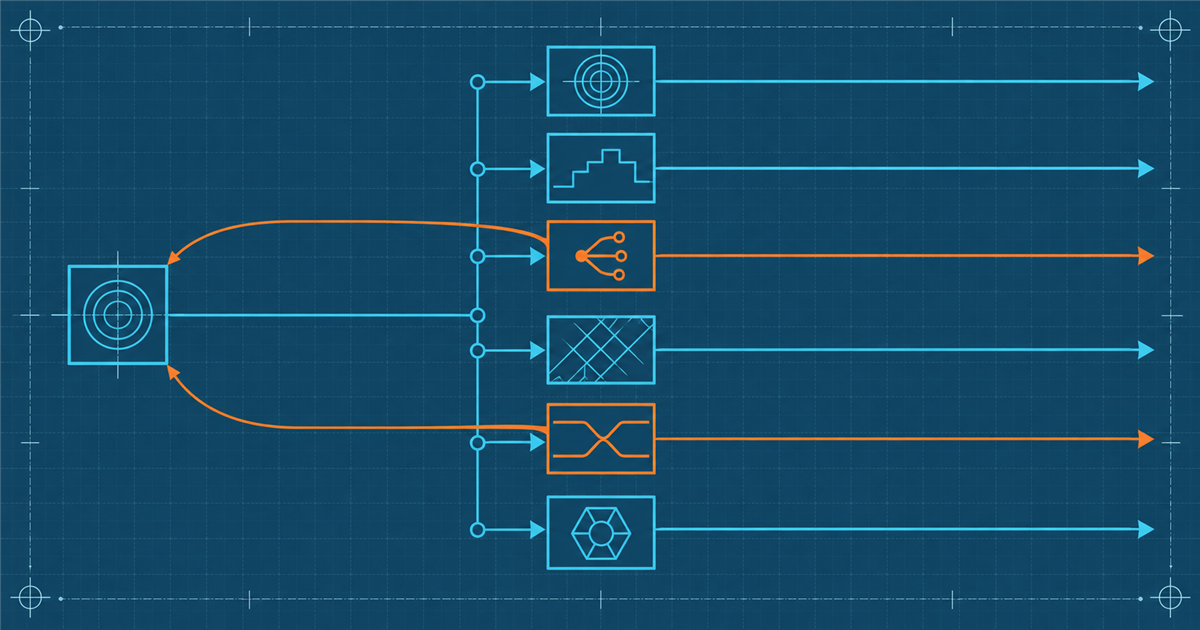
    A schematic of one source block feeding six transform blocks each emitting one output, two of the blocks amber with a rejection arrow curving back

    Validate before you publish

    This is the change that removes most of the pain, and it is the reason the completeness model in what a PIM actually does exists.

    Score every product against every rule set it is meant to satisfy, continuously. Show the result as a per-channel completeness figure with the missing fields named. Block publication for a product that does not pass. The queue of work then lives in your system, sorted by channel and field, and it can be assigned.

    Compare that with the alternative, which is that the channel validates for you, in its own time, and reports in its own vocabulary. The information is the same. The latency and the attribution are not, and those are what determine whether anything gets fixed.

    One caution worth stating: a completeness score is only as honest as the rule set behind it. Rule sets drift when a channel updates its specification quietly, which they do. Put a date on each rule set and review it, or your green dashboard will eventually be measuring last year’s requirements.

    Images are part of the feed and they fail differently

    Channels have image requirements: minimum dimensions, aspect ratio, background colour, no text overlay, a maximum file size, sometimes a specific format. These are the requirements most likely to be met by generating rather than by finding.

    If your renditions are derived from a master by parameter, meeting a new channel’s image spec is a mapping entry rather than a production task. A square crop on white at 2000 pixels for one marketplace and a 4:5 crop for another are two parameter strings against the same master, not two files someone makes and stores. The rendition model is what makes that possible, and it is the difference between adding a channel in an afternoon and adding one in a sprint.

    The image identity question is separate and worth being careful about. Some channels key on image URL and will re-fetch when it changes; others cache the first version they saw. Use stable URLs for the same content, change the URL when the content genuinely changes, and never reuse a URL for a different image.

    A tray of small embossed metal labels under raking teal light, five in the third row stamped off-centre and lit amber

    Rejection handling as a first-class flow

    You will still get rejections, because channels enforce things they did not document. Treat that as a routine flow rather than an incident.

    • Map their identifier back to yours on ingest, so a rejection report arrives as your SKUs. This single step saves more time than any other.
    • Classify by cause, not by product. Four hundred rejections are usually six causes. Fix the cause and the four hundred resolve together.
    • Feed the cause back into the rule set. Every undocumented rule you discover becomes a check you run before publishing, permanently. This is how the rule sets become more accurate than the specifications.
    • Keep the history. The same product failing repeatedly for different reasons means the record is thin, not that the channel is difficult.

    How often should a feed run?

    Less often than you think for the full catalogue, and much more often than you think for changes.

    A full regeneration is a reconciliation, not an update. Run it on a schedule that suits the channel’s tolerance, typically daily or weekly, and treat divergence found by it as a bug in the change path rather than as normal operation.

    Changes should propagate on change. Price and stock in particular have a short useful life, and a channel showing yesterday’s stock costs you more than the engineering to push it. Where a channel only accepts scheduled files, generate the file from live data at generation time rather than from a staged copy you maintain, which is the same argument made about internal integrations in wiring a DAM to a PIM.

    The structural prerequisite for all of this is a model that can express what the channels ask for. If yours cannot represent a variant grid or a localised attribute, the mapping layer will end up carrying data, which is where syndication projects go to die. Attributes, variants and the SKU problem and the product data model that survives growth cover that groundwork, and the human side of keeping the queue moving is in running product content as an operation.

  • Attributes, variants and the SKU problem

    Attributes, variants and the SKU problem

    A merchandiser asks how many products you have. The answer is either four hundred or eleven thousand, depending on who is counting, and both people are confident. That is not a reporting problem. It is the model showing through.

    Short answer: a SKU is a unit you sell. A product is a thing you describe. A variant is a product that differs from its siblings in a small, enumerated set of axes. Model these as three distinct levels, put each attribute at the highest level where it is still true, and the maintenance problem largely disappears.

    The three levels

    Family. Defines which attributes exist. All shirts have a fabric composition, a collar type and a fit. A family is a schema, not a thing you sell, and most catalogues need surprisingly few of them.

    Product. Carries the values shared by everything beneath it. The fabric composition of the Oxford shirt. Its care instructions, its brand, its story. This is the level a customer thinks they are browsing.

    Variant. Carries only what differs, along a small number of declared axes. Colour and size, usually. Sometimes a third, and if you find yourself needing a fourth it is worth checking whether one of them is really a separate product.

    The SKU is the identifier of the sellable unit, which is normally the variant. It is an inventory concept that has been borrowed by everyone else, which is why the same word means different things in a warehouse conversation and a merchandising one.

    Put each attribute at the highest level where it is still true

    That single rule does most of the work.

    Fabric composition is true of every variant of the shirt, so it sits on the product. Colour is not, so it sits on the variant. Weight is interesting: usually true at product level, occasionally variant level if sizes differ enough to matter for shipping, and if you are not sure, the safe answer is variant with a default inherited from the product.

    The failure mode when you get this wrong in the “too low” direction is duplication: the fabric composition stored thirty times, edited in twenty-nine places, wrong in one. The failure mode in the “too high” direction is a lie: a single weight value that is wrong for the extra large.

    Duplication is the more expensive of the two, because it degrades silently. A wrong value announces itself eventually. Thirty copies of a value that were all correct at the time just drift.

    The combinatorics, which nobody models for

    Six colours times five sizes is thirty variants. Add a fit and it is ninety. Add a market with its own copy and it is ninety times the number of markets in the fields that are localisable.

    That number is fine when it is generated and enforced. It is unmanageable when it is entered.

    Two consequences follow. First, variant creation should be generated from the declared axes, not typed, so that the thirty exist because six times five is thirty and not because someone made thirty rows. Second, the axes have to be enumerated in the model, so that “which colours does this come in” is a query rather than an inspection.

    There is also the case of the incomplete grid, which is normal and worth modelling deliberately. Not every colour comes in every size. A generated grid with explicit exclusions is maintainable. A hand-built list of the twenty-three combinations that exist is not, because nobody will remember why the other seven are missing.

    A steep teal curve against a flat pale baseline with the widening gap between them shaded amber

    Identifiers, and why you need more than one

    The catalogue needs at least three kinds of identifier and they are not interchangeable.

    Your internal identifier. Stable, meaningless, and never reused. Meaningless matters: an identifier that encodes the category will be wrong the first time a product is recategorised, and you will not be allowed to change it because it is printed on something.

    The external trade identifier. GTIN, EAN or UPC, issued under the GS1 system. Marketplaces increasingly reject listings without a valid one, and validity means the check digit computes and the prefix is actually yours. Borrowed or invented barcodes fail at the worst moment.

    The manufacturer’s identifier. MPN, if you resell. It is the only reliable way to reconcile your record with a supplier’s, and it is the field that makes data synchronisation with trading partners possible at all.

    Keep them in separate fields. The pattern of jamming several identifiers into one string with a separator survives until the first supplier whose identifier contains that separator.

    Where do images fit in the variant structure?

    At every level, and this is the part that catches people.

    Some images are true of the family, such as a size chart. Some are true of the product, such as a detail shot of the fabric. Most are true of the variant, because the blue one and the red one look different. A few are true of a combination that is not a variant axis, such as a lifestyle shot showing three colours together.

    The model that works is an association with a role, held on the product side: this asset, in this role, for this product or variant. Roles are a controlled list. Primary, alternate, detail, lifestyle, size chart, packaging. The channel mapping then says “the marketplace wants the primary plus up to six alternates”, and that is a query rather than a folder convention.

    What the model should not do is put the association in the asset system, for the reasons in DAM vs PIM, and it should not store crops per variant, because renditions are derived rather than stored.

    Macro of a fanned colour swatch deck under raking teal light with two identical amber blades sitting side by side

    When is flattening variants actually correct?

    Twice, and it is worth naming them because the general advice above is otherwise absolute.

    When variants are genuinely different products. If the blue one and the red one have different specifications, different regulatory status, different suppliers and different marketing, they are two products that happen to look similar. Forcing them into a variant grid produces a parent record with almost nothing on it.

    When your only channel demands it. Some marketplaces model everything as a flat list of sellable items with no parent concept. That is a channel mapping problem, not a modelling problem, and the correct response is to keep the structured model and flatten at export. The exception is if you have exactly one channel, forever, and no site of your own, in which case matching its model is defensible and you should write down that you did it on purpose.

    Everything else that looks like a reason to flatten is usually a tool that cannot express hierarchy, which is a reason to check the tool. The questions to ask about that are in what to demand from a PIM API before you buy, and the export-side consequences are in syndicating product data to marketplaces.

    The wider set of modelling decisions this one sits inside is in the product data model that survives growth, and if you are still working out whether a dedicated system is warranted at all, start with what a PIM actually does.