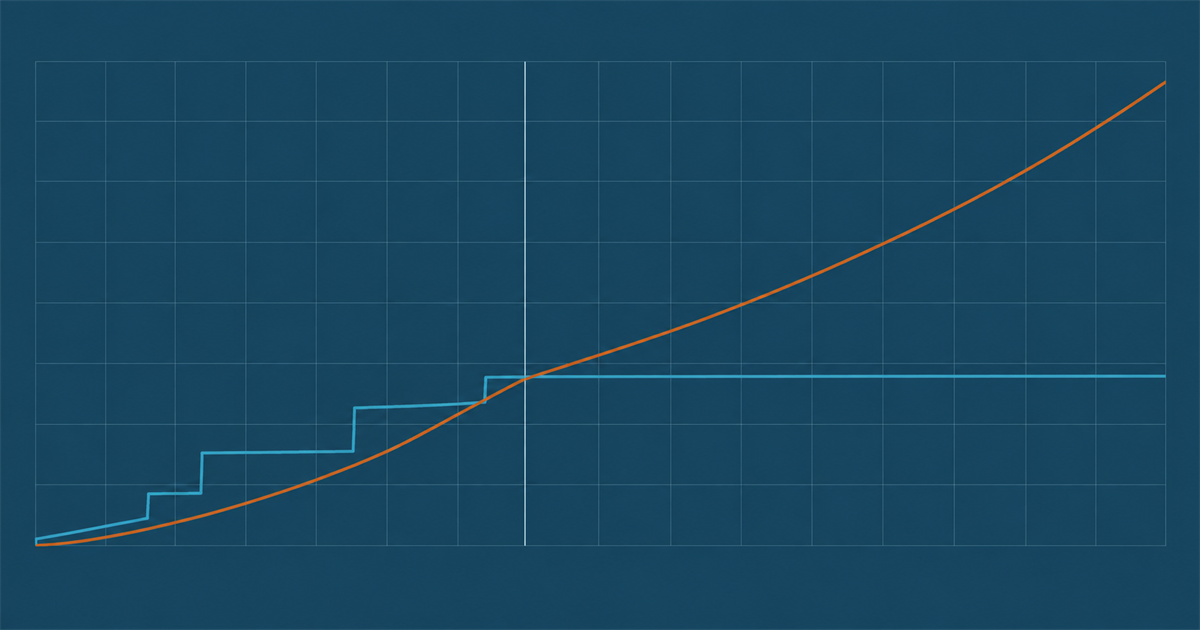
An engineering team looks at a product platform quote, looks at the feature list, and concludes correctly that they could build eighty per cent of it in a quarter. They are right. The trouble is the shape of the remaining twenty per cent, which is not eighty per cent smaller.
Short answer: building a product catalogue is defensible when your model is unusual and your channel count is low, and it is a permanent commitment rather than a quarter. Building a media delivery layer is almost never worth it, because the hard parts are format negotiation, caching and edge delivery, all of which are commodity and none of which are your product. Split the two decisions.
What you are actually buying
Strip the marketing and a product platform sells four things.
A modelling engine that can express families, products, variants, typed attributes and localised values, and enforce them. This is the part teams underestimate, because a first version is easy and the fifth revision is not.
A completeness engine that scores records against per-channel rule sets and blocks publication. This is the part that pays for itself.
A workflow layer with roles, states and assignment. This is the part most teams already have somewhere else and often do not need twice.
Channel mappings to marketplaces and retailers, maintained by someone else as those specifications change. This is the part with no ceiling, because the specifications change without asking you.
You can build the first three. The fourth is a subscription to someone else’s maintenance burden, and it is often the honest reason to buy.
The build case, stated fairly
There are real conditions under which building is correct.
Your model is genuinely unusual. Configurable products, made-to-order dimensions, service bundles, regulated goods with jurisdiction-specific field sets. If every platform demo ends with “we would handle that with a custom field”, building is worth costing properly, because a platform you have to fight is worse than no platform.
You have one or two channels and no plans for more. The channel mapping burden is what makes building expensive over time, and if you only ever publish to your own storefront, that burden is small and stable.
Product data is your product. Marketplaces, aggregators and comparison sites are in this position. Buying a generic catalogue to run a catalogue business is odd.
You have engineering capacity that is not otherwise committed. Not “we could find the time”. Committed capacity, permanently, because this becomes a system with an on-call rota.
If two or more of those are true, build is a real option. If none is, the discussion is usually about wanting to build rather than about needing to.
What the maintenance actually costs
The build estimate is nearly always for version one and the cost is nearly all after it.
- Schema evolution. Every new attribute type, every new market, every change to what localisable means. Small individually, continuous forever.
- Channel specification drift. Every marketplace changes its requirements at least annually, sometimes silently. Each change is a mapping update and a validation update, discovered through rejections.
- Import and export tooling. Suppliers send spreadsheets in whatever shape they like. Ingestion is a long tail that never ends.
- The interface. Cataloguers need one, and it is not a weekend project. This is the single most underestimated line in every build estimate.
- Concurrency and audit. Who changed what, when, and what did it look like before. Easy to skip in version one and painful to retrofit.
Cost the second and third years, not the first. A build that flattens after eighteen months is a good build; most do not flatten, and the curve to compare against is the total cost of ownership of the alternative rather than its licence line, as set out in what a DAM and a PIM actually cost.

The media layer is a different decision
Here the answer is much less balanced, and it is worth being direct about why.
Building a media layer means owning storage, format negotiation, resizing quality, caching, invalidation and edge delivery. Each of those is a solved commodity problem with a long tail of correctness issues, and none of them differentiates your business.
Format negotiation alone is a good example. Serving AVIF or WebP to browsers that support them and JPEG to those that do not, with correct Accept handling and cache keys that do not collide, is more subtle than it looks and has to be revisited as format support changes. Getting it slightly wrong produces either broken images for some users or a cache that serves the wrong format to the wrong browser, which is a bug that reproduces for nobody on the team.
The realistic build here is object storage plus a resizing service plus a CDN, which is three moving parts, an ongoing cost, and no metadata layer at all. That last omission is the important one: you have built delivery, not asset management. Nothing in it knows what an asset depicts, what is permitted, or which version is current.
The managed alternative starts free and stays cheap at small scale. Cloudinary’s Programmable Media free tier is 25 credits a month, where a credit is 1,000 transformations, 1 GB of storage or 1 GB of delivery. For a small catalogue that is not a trial, it is the whole requirement, and it comes with the structured metadata layer that the build-it-yourself version does not have.
The case for adopting it on day one rather than after you have built the three-part version is simply that the migration is the expensive part. Starting with a master and a URL costs nothing and gives you the structure from the first upload. Arriving at it eighteen months later means finding every stored derivative and every hard-coded path in every codebase, which is the argument made in full in DAM for developers.

The middle path most teams should take
Buy the media layer, build the thin catalogue, and keep the option open.
Concretely: put assets on a managed delivery platform immediately. Keep product data in whatever you have, modelled properly, with typed attributes and a real variant structure. Write the channel mappings as small, declarative, testable code rather than as a platform configuration. That combination costs almost nothing, and it produces a data model that can be loaded into a bought platform later without a cleanup pass, which is the expensive half of any migration.
The decision point comes when the channel mapping work starts consuming a person. That is the moment the subscription to someone else’s maintenance burden starts looking cheap, and it is a much clearer signal than any threshold based on catalogue size.
How do you decide this week?
Score four questions honestly. Is the model unusual, is the channel count above two, is engineering capacity actually committed, and is product data your product. Two or more yeses point to build, and fewer than two point to buy.
Then apply the same four questions to the media layer separately, and notice that the answers are almost always different. If they are not, one of the answers is probably wishful.
The threshold test for whether you need a bought catalogue at all is in do you need a PIM yet, the API questions that determine whether a bought one will integrate cleanly are in what to demand from a PIM API before you buy, and the lighter-weight options that are neither building nor buying are in alternatives to buying a DAM and a PIM.
Related field note
Continue with The build-versus-buy decision for ERP product identifiers.
Related field note
Continue with The build-versus-buy decision for catalog launch readiness.